
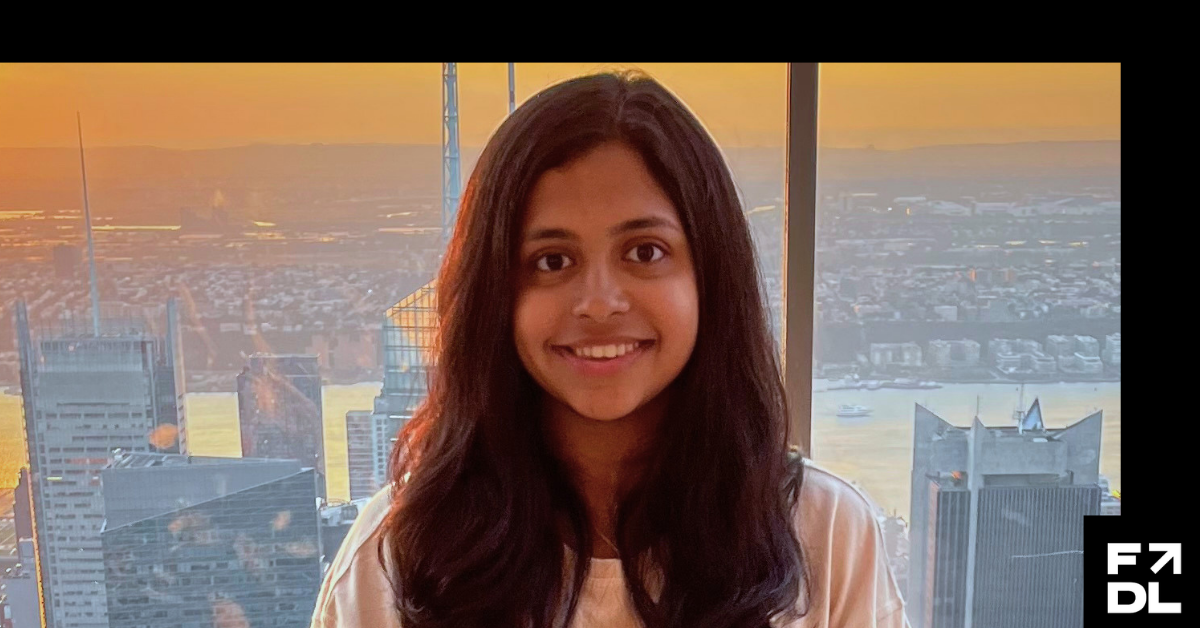
Meet Tanvee Manjure, Founder of The Desi Dictionary
“The way to get started is to quit talking and begin doing.”
Tanvee Manjure is part of a generation navigating identity across cultures, languages, and expectations. Based in London and working full-time in management consulting, she is also the founder of The Desi Dictionary, a venture rethinking how South Asian languages are learned, shared, and passed down in the diaspora.
Her work sits at a deeply personal intersection. Language, for Tanvee, is not just communication. It is memory, connection, and continuity. And yet, for many diaspora families, it is also something fragile, easily lost between generations.
“I’m building something that helps people stay connected to their heritage in a way that actually fits how we live today.”
The problem she refused to ignore
The idea for The Desi Dictionary did not begin as a business plan. It began as a quiet, familiar tension within her own family.
When her nephew was born, a simple question surfaced. How would the next generation stay connected to their language?
Like many second-generation families, Tanvee and her siblings grew up speaking their heritage language, but without the ability to read or write in its original script. The resources available assumed literacy that they did not have, or immersion that no longer reflected their lived reality.
“We realised none of the tools out there worked for us. They weren’t built for families like ours.”
The gap was not about interest or intention. It was about accessibility. Parents wanted to pass language on, but lacked tools that met them where they were.
That gap became impossible to ignore.
“If the system doesn’t work for us, we need to build one that does.”
The moment that shifted her focus
The turning point came through contrast.
Tanvee saw how her parents had passed language down to her, through immersion, repetition, and environment. But that same approach did not translate to her sister’s family, where English was dominant and multilingual fluency was uneven across the household.
The old methods no longer worked. And no one had built new ones.
“That’s when it became clear. If the system doesn’t work for us, we have to build one that does.”
What followed was not a sudden leap, but a decision. To start. To experiment. To create something practical, even if imperfect.
Her first step was simple. Transliteration-based word books for toddlers, designed for families who speak the language but cannot read its script.
Why The Desi Dictionary is different
The Desi Dictionary is built on a clear and deliberate shift in approach.
Instead of prioritising traditional literacy pathways, it starts with spoken connection. English transliteration comes first, allowing users to engage with language immediately, without needing to learn a new script.
“Our focus is conversation and connection over perfection.”
This is not about replacing traditional language learning. It is about making it possible in the first place.
By designing for the diaspora, not adapting existing tools, Tanvee has created something that reflects how language actually lives within modern families. Mixed households. Partial fluency. Cultural connection without formal structure.
It is both practical and emotional. A tool, but also a bridge.
How she leads
Tanvee’s approach to leadership is shaped less by theory and more by urgency.
She does not wait for perfect clarity before acting. She builds, tests, and improves in motion.
“Just doing it without hesitation, because it can always be improved.”
This mindset allows her to move forward despite constraints. A full-time job. Limited time. No guarantee of outcomes.
It also defines the culture she is building. One that values progress over perfection, and action over overthinking.
What she’s building right now
Her current focus is the next stage of The Desi Dictionary.
After launching her first transliteration-based books, she is now building an app, set to launch in July 2026. The goal is to expand access and create a more dynamic, scalable way for users to engage with South Asian languages.
“This is where it starts to become bigger than just a product.”
The app represents a shift from static resources to an interactive platform. One that can evolve with its users and meet a wider range of needs.
Founderland and finding her people
“Being part of Founderland means connecting with like-minded founders and finding mentorship.”
Building something that sits between culture, identity, and business can be isolating. The path is not always clearly mapped.
For Tanvee, Founderland offers both perspective and proximity. A community of founders navigating complexity, building with intention, and learning in real time.
It is not just about access to resources. It is about being in a room where the context is understood.
Her biggest challenge—and how she moved through it
One of the most persistent challenges has been time.
Balancing a demanding full-time role while building a company requires discipline and trade-offs that are often invisible from the outside.
“Finding the time to pursue this has been the hardest part.”
There is no clean separation between work and building. Progress happens in evenings, weekends, and in between moments.
Her solution has not been to wait for more time. It has been to work with what exists, and to keep moving, even if the pace is uneven.
Who inspires her
Tanvee draws inspiration from Diipa Khosla. She admires how Diipa has built a brand that celebrates South Asian identity with confidence and pride, while combining strong storytelling with strategic marketing.
“It’s about owning your culture and presenting it on your own terms.”
How she stays grounded
“I stay motivated because I care deeply about this.”
Her work is driven by a clear urgency. Without intervention, languages risk being lost across generations. That sense of responsibility keeps her creative, focused, and consistent.
A mantra she lives by
“The way to get started is to quit talking and begin doing.”
Follow Tanvee’s Journey
Learn more or get in touch:
🌐 www.thedesidictionary.com
💼 Instagram: @thedesidictionary_
🎵 TikTok: @thedesidictionary