
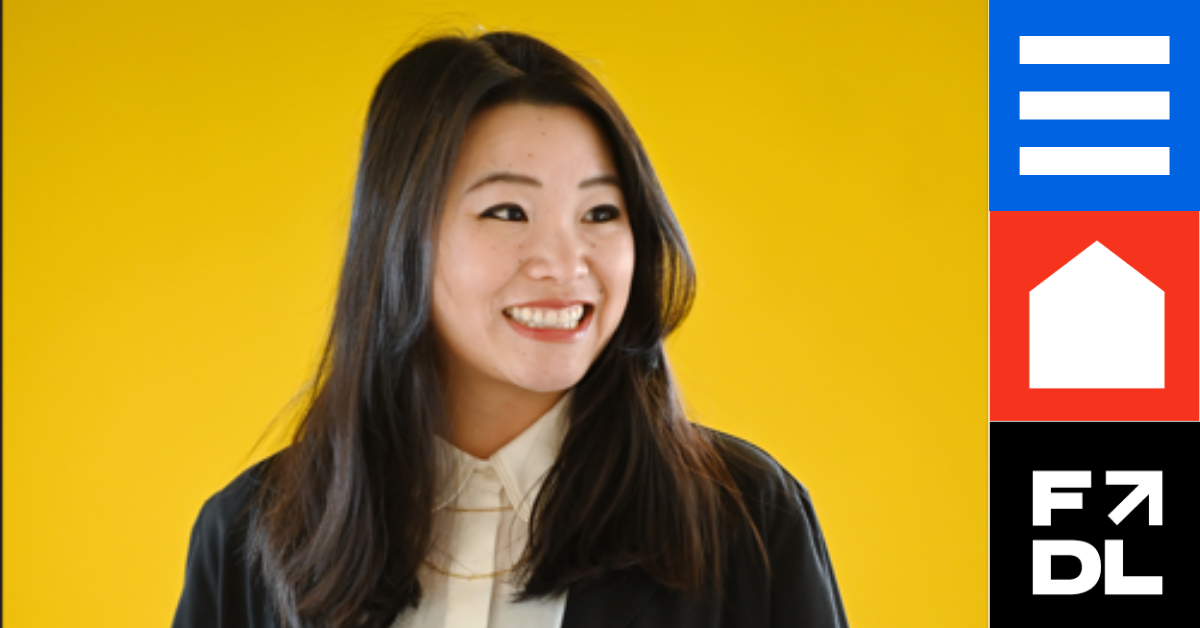
For 6.5 years, Katty Hsu studied the funding gap facing women entrepreneurs. Then she kept hearing the same thing: women had “training fatigue.” With VUKARA, she is turning years of research into an ecosystem where early-stage women entrepreneurs can access something more tangible: capital, expertise and networks.
Entrepreneurship runs through Katty Hsu’s family.
She was born in Taiwan, raised in South Africa and now lives in Rotterdam. Before her, generations of women in her family made their own journeys across continents, from China to Taiwan to South Africa, building ventures along the way.
“I was raised by ambitious women, each generation crossing oceans to start their ventures.”
Those women had access to opportunities that changed what was possible for the generations that followed. Katty eventually carried that story with her into a research career in Europe, where she began looking more closely at who gets the same opportunities to build today.
Across countries and ecosystems, she kept finding variations of the same problem.
Women create enormous economic value. The systems around entrepreneurship continue to undervalue it.
Katty spent the next 6.5 years studying the funding gap and working across research, education, programme design and founder support.
Eventually, studying the problem was no longer enough.
When another training programme isn't the answer
There is no shortage of programmes designed to help women become better entrepreneurs.
Workshops. Accelerators. Training. Mentorship.
All can be useful.
But while researching the funding gap across the Global Majority, Katty repeatedly heard a phrase that stayed with her:
“Training fatigue.”
Women had learned how to pitch. They had attended the workshops. They had developed their skills.
The underlying problem remained.
“In the end it's all about money.”
That was the moment Katty's thinking shifted.
If she wanted to work seriously on the funding gap, the solution itself had to involve money.
It also needed to recognise that capital is not the only resource that determines whether a business survives.
Time has value.
Expertise has value.
And knowing the right person can change the trajectory of a company.
Those ideas became the foundation for VUKARA.
More than one kind of backing
VUKARA describes itself as an “ecosystem for equality.”
Its focus is women entrepreneurs from the Global Majority, particularly during the critical two-to-five-year period when a business has made it beyond its earliest beginnings but remains vulnerable.
Instead of treating funding as a single transaction, VUKARA is building a model where backers can contribute in several ways.
Capital is one.
Their time and expertise are another.
Their networks are another.
Through VUKARA's digital platform, the aim is to connect entrepreneurs with people who can provide the particular form of backing they need to move forward.
For Katty, this matters because the funding gap is not only about the amount of money available.
It is also about who has access to the relationships surrounding money.
A founder with the right introduction, an experienced person willing to solve a specific problem, or someone who can open a door may have an advantage that never appears on a balance sheet.
VUKARA wants to make more of that advantage accessible.
From research to a real-world test
After months of building behind the scenes, Katty and her co-founder are now taking the idea into the real world.
Their first pilot is in Kenya.
It is a significant moment for a founder who has spent years researching the problem from a distance.
For the pilot, VUKARA will begin making its first matches between women entrepreneurs and backers around the world.
That means the hypotheses begin meeting reality.
Will people contribute expertise alongside capital? Which kinds of support do founders actually value most? Can relationships that usually depend on personal networks be made more accessible?
For Katty, this is the exciting part.
The research has already happened.
Now comes the building.
Standing on the shoulders of giants
Moving closer to money has also brought Katty into unfamiliar territory.
Finance comes with regulation, legal questions and compliance risks that are very different from the worlds of research and programme design she knows well.
She is candid about still learning.
Her approach has been to resist the temptation to solve every problem from first principles.
“Don't reinvent the wheel.”
Instead, she looks for models that have already demonstrated what is possible and asks what VUKARA can learn from them.
One person she looks to is Dr. Serey Chea, Governor of the National Bank of Cambodia.
Katty is particularly inspired by Bakong, Cambodia's digital payment system, and its potential to expand access to financial services.
For her, it is an example of what becomes possible when inclusion is treated as a question of system design.
“When we say at VUKARA that we are building an ‘Ecosystem for Equality,’ it is because we are inspired by cases like Bakong that reshape systems to drive grassroots financial inclusion.”
The ambition is not simply to help individual women navigate the system better.
It is to rethink parts of the system itself.
The Lead Navigator
At VUKARA, Katty calls herself the Lead Navigator.
Her co-founder, Anna Klapwijk, is the Lead Explorer.
The titles are playful, but Katty's choice reflects something real about how she works.
Having called three continents home, she has become comfortable moving between different people, cultures and ways of seeing the world.
Her strength, she says, is mapping what lies ahead.
“I’m building with my co-founder by bringing my strength in mapping out the opportunities ahead and directing us towards where we can make the most impact.”
There is an obvious connection to her research background.
Katty likes understanding the terrain.
She likes seeing how pieces connect.
And she likes knowing where she is going.
As a founder, however, she has also had to learn when that instinct becomes a constraint.
It doesn't have to be perfect
If Katty could give her past self one piece of advice, it would be simple:
“It doesn't have to be perfect.”
She has a tendency to want everything in order before moving forward.
The plan. The structure. The details.
But entrepreneurship rarely rewards waiting until every piece is settled.
“I put too much pressure on myself to get everything ‘in order’ before proceeding.”
The irony is that some of the work that gives Katty the most energy happens outside that preparation: building, meeting people and making connections.
Learning to move before everything feels finished has therefore become part of her founder journey.
Her favourite Founderland symbol is “Expanding” for much the same reason.
The arrows point in different directions.
They remind her that growth doesn't follow a straight line.
Getting out of her head
For someone whose work has required years of research and thinking, Katty has learned that resilience sometimes means doing the opposite.
Getting out of her head.
Getting into her body.
She paints. She tries new things. She aims to exercise for at least 20 minutes a day. And she takes rest days when she needs them.
Protecting her mental and creative health is part of the work, rather than something she earns after completing it.
Her mantra is appropriately ambitious:
“Shoot for the moon. Even if you miss it you will land among the stars.”
But there is a pragmatism underneath that ambition too.
The company doesn't need to be perfect before it can begin.
Katty doesn't need to know everything about finance before entering the field.
And the route from research to impact does not need to be linear.
She needs to keep moving.
Building the ecosystem she believes should exist
For Katty, Founderland is an example of what happens when community becomes infrastructure.
“Community and meaningful connections mean everything to me and what we're building.”
It is particularly meaningful to be surrounded by women across Europe who are building on their own terms while actively supporting one another.
That principle sits at the centre of VUKARA too.
Entrepreneurship is often framed as an individual achievement. Katty's work asks us to look at everything surrounding the individual instead.
Who had capital?
Who had time?
Who made an introduction?
Who shared expertise?
Who opened the first door?
Her own family history taught her what access to opportunity can make possible across generations.
Six and a half years of research taught her how unevenly that opportunity is still distributed.
Now, with VUKARA, she is trying to build more of it.
Follow Katty’s Journey
Stay in the loop: